

Takeoff · Estimate · Quote · Get paid
Construction estimating software that doesn't stop at the estimate.
Drawings, site photographs or the client's own schedule of works, measured and priced against your own rates. Everything after that runs off the same numbers, so nothing is re-keyed between the estimate and the final account.
No card. One active project, three takeoffs and three AI estimates · book a demo
Three ways a job arrives
Three ways a job arrives. All three end in the same priced estimate, costed against your own rates and readable line by line.
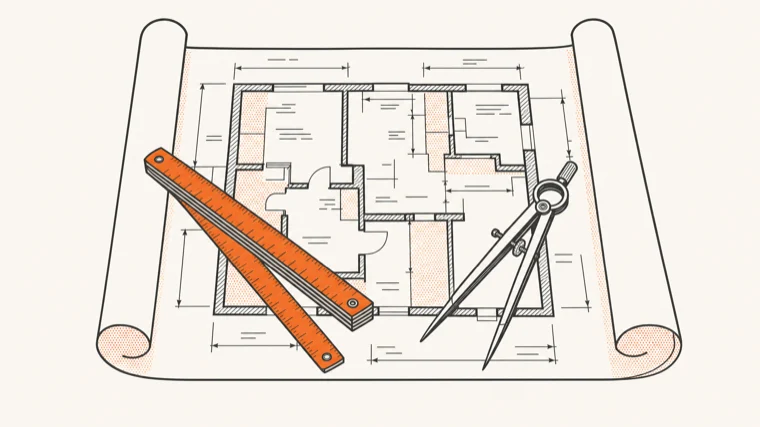
Drawings
A plan set, elevations, a tender drawing.
It measures room by room off the dimensions annotated on the drawing, then builds an area schedule and a list of trade packages. Every quantity is graded high, medium or low, so you check the handful it was unsure about instead of re-checking all of them.
PDF · JPG · PNG, up to 20 pages of a drawing set

Site photographs
No drawings. Just the job in front of you.
Walk it with a phone. Each photograph is read for what is there and what condition it is in, and the scope of works is written from that. Anything a camera cannot measure comes back named: the one or two figures somebody still has to take with a tape.
JPG · PNG · HEIC, up to 24 photographs a run
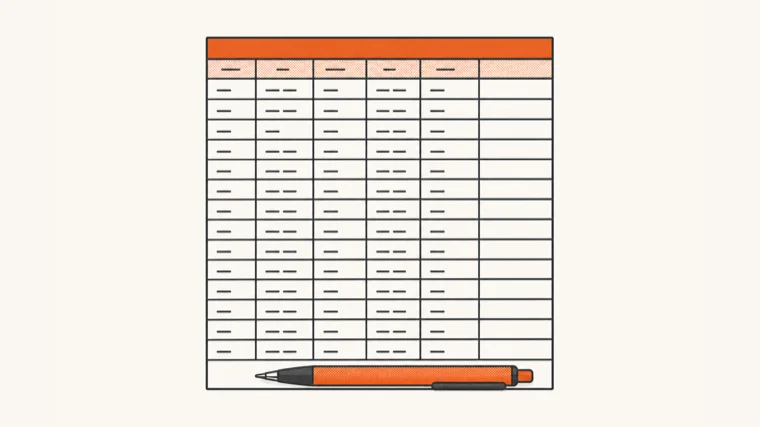
Their schedule of works
The client sent a spreadsheet with an empty rate column.
Every line priced inside their own structure. Their sections, their item references, their wording, their order, and handed back as a copy of the file they sent. Their original is never modified.
.xlsx · .xls · .ods · .csv in, filled and returned as .xlsx
Who it's for
Groundworks prices differently from fit-out.
And a painter quoting his own scope prices differently again, off a walk-round, not off a drawing. Pick the work you actually do.




Not on the list? It probably still works. Start free and find out on a job you already know the answer to.
Watch it work
Whatever goes in, a priced document comes out.
The same four steps run whether it started as a drawing, a set of site photographs or a spreadsheet somebody emailed you. Below is a measured takeoff off a drawing, filling in as it runs.
| Description | Qty | Unit | Material | Labour | Total |
|---|---|---|---|---|---|
| Kitchen extension, measured takeoff | Returned to client | ||||
| PrelimSite set-up, welfare and skip hire | 1 | item | £480.00 | £1,240.00 | £1,720.00 |
| GroundBreak out existing slab and cart awayHIGH | 42 | m² | £310.00 | £2,058.00 | £2,368.00 |
| CarpTimber package, studs, plates, joistsMED | 1 | item | £4,860.00 | £3,240.00 | £8,100.00 |
| Carp18mm OSB boarding to studworkHIGH | 38 | m² | £646.38 | £874.00 | £1,520.38 |
| VarFlooring swap, flagged out of scopePriced variation, awaiting client approval | 1 | item | £1,400.00 | £1,000.00 | £2,400.00 |
| Job total | £7,106.38 | £9,072.00 | £18,578.38 | ||
A worked demonstration of the mechanism, not a case study. The totals are the sum of the lines above them.
- 01
It reads what you gave it.
A drawing is measured room by room off the dimensions annotated on it. A photograph is read for what is there and what condition it is in. A client's schedule is recorded exactly as sent. Their sections, their item references, their wording, their order, because that row identity is what lets it be handed back in their document rather than in ours.
- 02
It prices off your rate book.
Every line costed against your own materials and labour roles. Choose price-book-only, and it uses nothing but your rates. Choose full buildout, and it will find a figure for something you have never bought before, and tell you which lines those were.
Try it on a job you've already priced - 03
It marks what it isn't sure about.
Quantities come back graded high, medium or low confidence. A line it cannot price is left blank with the reason attached, not filled with a plausible number. Anything a photograph cannot measure comes back named: the one or two figures somebody still has to take with a tape. You check the handful it flagged instead of re-checking all of them.
- 04
It goes out as a document you can send.
A branded quote. Or, if they sent you a schedule, a copy of their own workbook with only the rate, total and comments cells written. Column widths, headings, merged cells and their formulas are untouched, because nothing was rebuilt. The file they sent stays exactly as it arrived.
One real job
A client sent a 33-item schedule of works. It came back priced to within about 6% of their own estimator.
Not a drawing. Their spreadsheet, with a rate column left empty. BuiltUp priced all 33 items and returned the same document: their sections, their item numbers, their wording, in their order. Their estimator had already priced it by hand. The two totals were within about six per cent of each other.
That is one job, not a benchmark, and we are not going to present it as one. What lands on your schedule depends on your own rates. Check it against your own figures before it reaches a client, which is why it comes back as a document you can read line by line.
The same pricing comes off a drawing or a set of site photographs. A schedule is just the version you can hold up against the original.
How the round trip works| As you sent it | Priced by BuiltUp | |||||
|---|---|---|---|---|---|---|
| Item | Description | Qty | Unit | Material | Labour | Total |
| APreliminaries /Generally3 items | Mat£1,120.00 | Lab£3,285.00 | Subtotal£4,405.00 | |||
| 1 | All builders' workmanship shall be completed… | 1 | ITEM | – | £185.00 | £185.00 |
| 2 | The following significant risks and standards have been identified… | 1 | ITEM | – | £240.00 | £240.00 |
| 3 | Allow for all contractors general cost items… | 1 | ITEM | £1,120.00 | £2,860.00 | £3,980.00 |
| BMEASURED WORKS30 items | Mat£18,640.00 | Lab£24,905.00 | Subtotal£43,545.00 | |||
| 5 | Damp repairs, investigate cause of dampness / mould… | 1 | ITEM | £310.00 | £680.00 | £990.00 |
| 6 | Demolition, strip out all existing IPS panelling and framework… | 1 | ITEM | £145.00 | £2,420.00 | £2,565.00 |
| 9 | Flooring, supply and lay 2.5mm thick Polysafe Standard vinyl… | 1 | ITEM | £1,865.00 | £1,540.00 | £3,405.00 |
| 11.2 | Supply and fix 6no (total), back to wall floor mounted WC pans… | 1 | ITEM | £2,394.00 | £1,080.00 | £3,474.00 |
| 19 | Investigation works into existing drainage system, rodding…Not priced, needs further information | 1 | ITEM | – | – | – |
| Job total | Material£19,760.00 | Labour£28,190.00 | Total£47,950.00 | |||
27 more items in this schedule25 more items in this schedule
Sections, item references, wording, quantities and units are from a real 33-item client schedule of works, anonymised. The figures are a worked demonstration, not that client's return.
Their document, not ours
Sections, item numbers, wording and order come back exactly as they were sent. Column widths, headings, merged cells and their own formulas are left alone, because only the rate, total and comments cells are written.
Their original is untouched
The file they sent is kept exactly as it arrived. The priced copy downloads separately, so there is never a version of the client's document that has quietly changed underneath them.
Nothing is guessed
A line we can't price is left blank and says so in the comments column, rather than being filled with a plausible number or dropped from the schedule. You can see what needs your judgement before it goes back.
Three ways to read it
The working grid, their specification priced, and a comparison putting our figure next to your own estimate and the final account. The two variances are kept apart, never averaged into one.
What it can and can't hand back
A priced Excel workbook comes back in its original layout. A CSV, an OpenDocument sheet or a legacy .xls is read and priced on screen, but only an Excel file can be filled in and returned as itself.
No card. Test it on a job you already know the answer to.
After the estimate
The estimate is where it starts.
The numbers carry forward from the priced scope, so nothing gets re-keyed between the quote and the final account.
However the job arrives
- DrawingsA plan set, elevations, a tender drawing.
- Site photographsA walk round with a phone.
- Their schedule of worksThe spreadsheet the client issued.
Priced once
One estimate
And carries into
- Winning itQuote, client portal, finish selections, contract.
- Running itProgramme, purchase orders, subcontractors, RAMS.
- Getting paidInvoices, variations, evidence pack, reporting.
Every line is costed against your own materials and labour, with a confidence grade on the quantities.

The same job from the client's side. They get the quote, the programme, the invoices and the messages at one address, which is also where the approval you need comes from.
Pricing the work
- Takeoff from drawings
- Scope from site photographs
- A client's schedule of works, priced
- Your own rates
- Supplier price lists, read from a PDF
- Schedules of rates and term contractsUltimate
Winning it
- Quotes
- Client portal
- Finish selections
- Contracts and e-signature
Running it
- ProgrammePro
- Progress against plan
- SubcontractorsUltimate
- Purchase orders
- RAMSPro
Getting paid, and keeping the record
- Invoices and staged payments
- Variations
- Evidence packPro
- Reporting
The middle two of those, from the signed contract through to the WIP figure, are written out on run the job.
A label marks the plan a capability starts on. Everything without one is on every plan, including the free one. The full split is on the pricing page, with what an extra seat costs.
Measured term work
BetaUltimatePrice to your own schedule of rates.
If you hold a measured term contract with a housing association, local authority or NHS trust, you don't price from first principles. You price from a schedule. BuiltUp imports yours, applies your contract adjustment, and codes each measured line against it. Works with the published schedules used across UK social housing and public-sector repairs, and with bespoke term-contract schedules.
Import your own schedule
Excel, OpenDocument or CSV. Column mapping is suggested and previewed against real rows before anything is saved, so a rate column read one across is caught before it prices a job.
Contract uplift, applied automatically
Create a term contract carrying your agreed percentage adjustment, an uplift or a tendered discount, and bind a job to it. Every coded line shows the published base rate next to the adjusted rate, so the arithmetic is auditable.
Unit-filtered coding
Lookup is restricted to units compatible with what you measured, so a square-metre measurement can't be priced against a per-item code by accident.
Reissues don't move old money
Schedules reissue annually. A new edition imports as a new schedule alongside the old one, and live contracts stay on the edition they were let under. Quotes already raised keep the rate, unit and edition they were priced at.
You supply the schedule and the licence. BuiltUp does not supply, resell or redistribute rate data. How schedules of rates work

After the site closes
Estimating is the part that happens after everyone has gone home.
The hour at the kitchen table with a tape, a merchant's price list and last year's spreadsheet, priced late, sent late, and won or lost on a number you were too tired to check. That hour is what this is for.
When it matters
What happens when something goes wrong.
The question worth asking about any tool that holds your pricing. Here is the honest answer to it.
Book a walkthroughOn the job
The estimate goes where the job is.
Most pricing gets done at nine at night because the tool for it is on a desk. The iOS and Android apps carry the same jobs, the same rate book and the same numbers, so a change made standing in somebody's kitchen is the change the office sees.
Price it in the van
Open the job, adjust a rate, see the profit move. The figure on the phone is the figure in the office, because it is the same job.
Photograph the works
Shoot the condition as you walk it and dictate what needs doing. Both land on the project rather than in your camera roll.
Chase what you are owed
Outstanding, overdue and who has not paid, on the screen you already have in your hand.
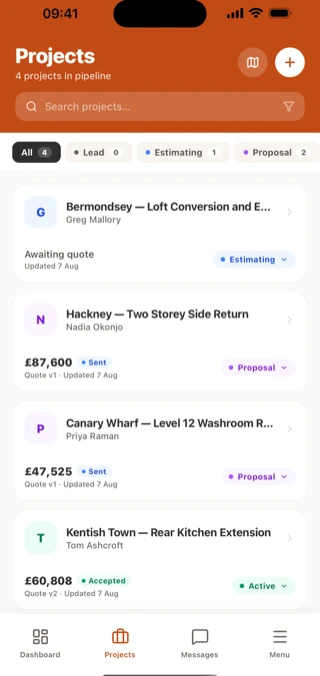
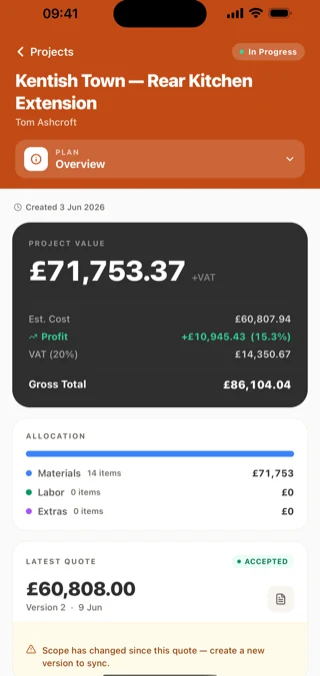
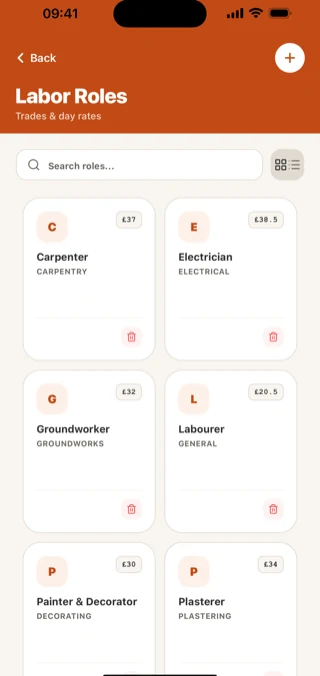
What stays on the desktop: measuring a drawing, generating an estimate with AI, coding to a schedule of rates, and handing a client's spreadsheet back in their own format. Those want a big screen and they have one. See the full platform
Pricing
Start free. Pay when it's making you money.
One active project, three takeoffs and three AI estimates cost nothing and need no card. Everything else is £79 or £149 a month, printed here rather than hidden behind a call.
Which is you?
Free
Run a real job through it before you pay anything.
1 seat · free forever
- 1 active project
- 3 AI scope generations
- Price a client's schedule of works, returned in their own spreadsheet
- Import a supplier price list from a PDF
- Contracts for clients and subbies, with industry templates
- Client portal and finish selections
6 more on Free
- Material tiers, good, better, best
- Scope templates, saved and reloaded
- Variations and invoicing
- Card payments via Stripe
- Your own branding on the portal and on what you send
- BuiltClip browser extension
No card · Free forever
Pro
Most popularFor anyone quoting most weeks, with margin to protect.
5 seats · billed annually
Everything in Free, plus:
- Unlimited projects
- Unlimited takeoffs and AI estimates
- Scope Creep Guard, out-of-scope asks flagged from the client's own messages
- Dispute Shield, the record sealed and dated
- Auto Health & Safety, RAMS drafted from what's priced on the job
- Purchase orders
5 more on Pro
- AI scheduling, with the forecast read into the programme
- Material Delay Guard
- Live supplier price sync
- Overrun cost forecasting
- Extra seats available
Card required · Nothing charged for 30 days
Ultimate
For firms working under term contracts.
10 seats · billed annually
Everything in Pro, plus:
- Schedule of rates, price to your own NSR, M3NHF or in-house schedule (beta)
- Subcontractor portal
- Custom roles and permissions
- Push invoices into Xero or QuickBooks
- Multiple workspaces
- Advanced financial reporting
1 more on Ultimate
- Priority support
Card required · Nothing charged for 30 days
Before you decide
Read how it works before you hand it a real job.
The next job lands on Thursday.
Drawings, photographs of the job, or a spreadsheet with an empty rate column. Put it through, see it priced, and decide from there.
No card. One active project, three takeoffs and three AI estimates · See pricing