How AI Is Transforming Construction Estimating in 2026
Construction estimating used to mean a kitchen table, a legal pad, and a calculator. In 2026, artificial intelligence is rewriting that playbook. Contractors who adopt AI estimating are winning more bids, with better margins, in a fraction of the time it used to take. Here is exactly what is happening and how to take advantage of it.
Why Traditional Estimating Is Losing You Money
The old process is brutal. You visit a site, scribble notes, drive home, open a spreadsheet, price every line from memory or last year's supplier list, and hope you didn't miss a trade. According to the National Association of Home Builders (NAHB), the average residential contractor spends 6–12 hours preparing a single bid. For many small firms, that means only 3–5 bids per week — and a close rate of maybe 25%.
Those numbers are not just an inconvenience. They are a direct hit to revenue. Every hour spent estimating is an hour not spent on the job site, managing subs, or meeting the next client. And spreadsheet-based estimates carry a documented error rate of 5–15%, according to research published by the Associated General Contractors of America (AGC).
What AI Estimating Actually Looks Like in 2026
Forget the sci-fi hype. Practical AI estimating boils down to three capabilities that are shipping in real products today:
1. Voice-to-Scope
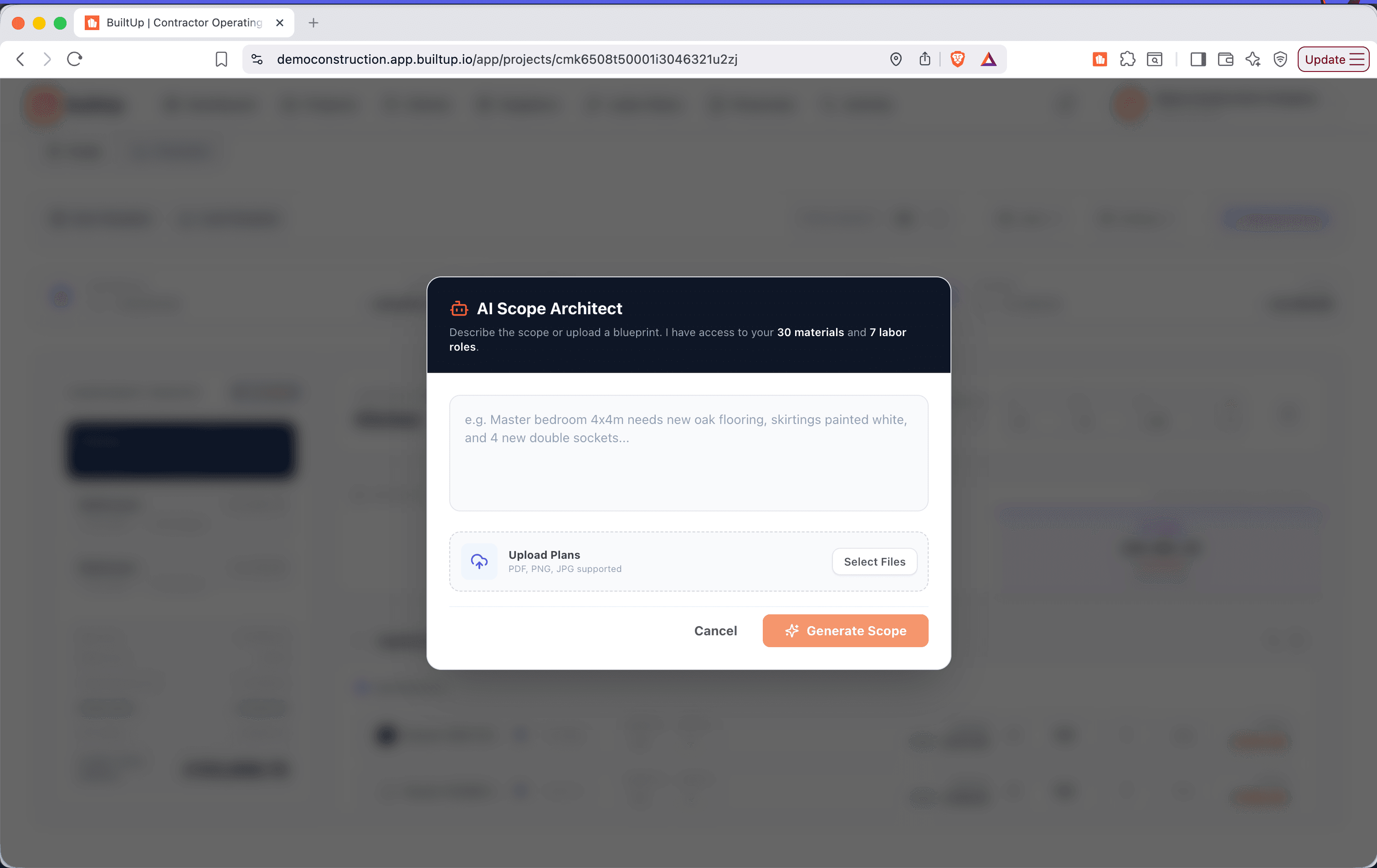
You walk a job site, speak into your phone — "two-story colonial, roughly 2,800 square feet, full kitchen gut, three-bath remodel, new HVAC" — and the AI returns a structured scope of work within seconds. It maps your voice input to a line-item database, pulls regional material pricing, and applies your historical labor rates. BuiltUp's voice-to-scope feature, for example, generates an editable scope that contractors can review and send from the parking lot.
2. Blueprint Analysis
Upload a PDF set of plans and the AI performs a digital takeoff: counting doors, windows, outlets, and fixtures; measuring linear footage of walls; and calculating square footage by room. What used to take a junior estimator an entire day now happens in minutes with accuracy rates above 95%.
3. Real-Time Material Pricing
AI platforms connect to supplier databases and adjust unit prices in real time. When lumber spikes, your estimate reflects it immediately — no more finding out after the contract is signed that your framing numbers are six weeks stale.
Traditional vs. AI Estimating: A Head-to-Head Comparison
| Factor | Traditional Estimating | AI-Powered Estimating |
|---|---|---|
| Time per estimate | 6–12 hours | 15–45 minutes |
| Error rate | 5–15% | 1–3% |
| Material pricing | Manual lookup, often stale | Real-time supplier data |
| Scalability | Limited by headcount | Unlimited bids per week |
| Learning curve | Years of field experience | Template + AI = day one |
| Cost | $60K–$90K/yr for a full-time estimator | $49–$299/mo for software |
| Consistency | Varies by person | Standardized every time |
How Accurate Is AI Estimating — Really?
Skepticism is healthy. Any contractor who has been burned by a bad number knows the stakes. Here is what the data says:
- Material quantities: Blueprint-analysis tools consistently hit 95–98% accuracy on takeoffs for standard residential plans. Complex commercial projects with unusual geometries still benefit from human review.
- Labor hours: AI models trained on historical project data from thousands of jobs converge within 3–5% of actual hours. The key is feeding the model your crew's productivity, not national averages.
- Total bid accuracy: Contractors using AI report final project costs within 2–4% of the original estimate, compared to 8–12% variance with manual methods.
"We went from spending all weekend on a single bid to sending three accurate proposals before lunch on Monday. The ROI was obvious within the first month."
What to Look for in an AI Estimating Tool
Not every tool that slaps "AI" on the label delivers real value. Here is a checklist for evaluating platforms:
Must-Have Features
- Voice or mobile input — you need to estimate from the field, not just from a desk.
- Editable line items — AI should produce a draft, not a locked document.
- Regional pricing data — national averages are useless for a GC in Denver versus one in Miami.
- Template library — reuse scopes for similar project types to save even more time.
- Integration with your workflow — does it connect to your invoicing, scheduling, and client portal?
Red Flags
- No ability to override AI suggestions — you need control.
- Pricing data with no visible source or date — stale data is worse than no data.
- No mobile app — if you cannot use it on-site, you will not use it at all.
- Long-term contracts with no trial — legitimate tools let the work speak for itself.
Cost Comparison: Hiring an Estimator vs. AI Software
For a growing contracting business, the math is compelling. A full-time estimator costs $60,000–$90,000 per year in salary alone, plus benefits and overhead. An AI estimating platform like BuiltUp runs $49–$299 per month depending on volume. Even at the top tier, that is $3,588 per year — roughly 4–6% of the cost of a human estimator.
This does not mean AI replaces people. The best contractors use AI to handle the first 90% of the estimate, then apply their field knowledge to fine-tune the remaining 10%. The result is more bids, better accuracy, and the estimator (or the owner, in a small shop) freed up for higher-value work like client meetings and negotiations.
Frequently Asked Questions
Is AI construction estimating accurate enough for commercial projects?
For standard commercial fit-outs and tenant improvements, yes. Complex new-build commercial with unusual structural systems still benefits from a professional estimator reviewing the AI output. The AI handles the repetitive takeoff work; the human handles the judgment calls.
Will AI estimating replace human estimators?
No. It will replace the manual, repetitive parts of the job — takeoffs, pricing lookups, formatting. Experienced estimators become more productive, not obsolete. Think of it like how GPS did not replace drivers; it made them faster and more reliable.
How long does it take to set up an AI estimating tool?
Most platforms, including BuiltUp, are usable within a day. You import your labor rates, select your region, and start estimating. The AI improves as you use it — learning your preferences, markup, and trade patterns over time.
What about data security for my project files and pricing?
Reputable platforms use bank-level encryption (AES-256) and SOC 2 compliance. Your blueprints and pricing data should never be shared with competitors. Always ask vendors for their security documentation before uploading plans. The Associated Builders and Contractors (ABC) publishes guidelines on technology vendor evaluation for construction firms.
The Bottom Line
AI construction estimating in 2026 is not experimental — it is mainstream. The contractors who adopt it are bidding more, winning more, and protecting their margins with tighter numbers. The ones who don't are spending weekends with spreadsheets while their competitors send proposals from the job site.
Whether you are a one-person remodeling shop or a 50-crew GC, the tools exist today to cut your estimating time by 80% and your error rate by half. The question is not whether AI estimating works. The question is how many bids you are willing to lose before you try it.